
Top Ten lists are pretty pointless. Whether it’s a respected artist detailing their favorites in their profession, an academic listing the most influential works in their field, or simply a phantatic with a blog ranting, it is impossible to reach a definite, objective top ten list in anything. Ironically, there was a list, a top 100 list in fact, that changed my life.
I watched the American Film Institute Top 100 Tenth Anniversary list on T.V. when I was twelve upstairs on a Friday night with my older sister. I don’t know what it was but I remember seeing commercials for it for about a month and every time I saw it I desperately wanted to watch it. I don’t know if it was because of the dozens of VHS’s my family owned and the hundreds of hours I had watched those movies growing up. I’d like to think it was a calling from God to spread my love of film to others but that might be a stretch. I had never really seen many of the movies on the list but somehow as I watched it that night I was enchanted with old Hollywood, the silents, and the iconics. I was mystified by the snip bits of classic American film they played as they unveiled movies I had never seen or ever heard of before.
The thing about this list was it marked the beginning of me watching and loving film. It took a few years until I got the chance to see many of these films and a few remain as my all-time favorites and personal films. Some didn’t quite cut it for me even though hundreds of active filmmakers voted and vouched for these films. A good top ten, top 100, or top whatever list isn’t meant to rank the best movies objectively but instead is an opportunity for the one making the list to share what personal experiences they have had and open the window for others to share these experiences and make new ones of their own. So hopefully this list doesn’t create disgruntled readers wondering why this or that was left out but allows for those who read it to reflect on their own experiences and to explore new genres and areas. Enjoy!

- The Kid (1921)
In this state, I happened upon The Kid on Turner Classic Movies one weekend night. 'I’ve never seen a silent movie before', I remember thinking as I opted, out of curiosity, to watch an almost century old movie instead of any of the dozen of guns-a-blazing action movies most teenager boys would be watching on T.V. that night. It was a revelation. It was transcendent, seeing something made two years before my own grandma’s birth that seemed so fresh, funny, and unique. I’ve never seen anything that shook my notions of film as much as when I first saw the brilliant slapstick of Charlie Chaplin. He didn’t need to speak to create laughs, just his gags, situations, and a few title cards and the camera. It really opened up for me the visual power that film could reach.
The Additional Three: Harold Lloyd’s Girl Shy (1924): Probably my favorite silent film comedy which is still surprisingly relatable. Romance and comedy done right. Buster Keaton’s The General (1926): The first film I watched in my Intro to Film class in college and the whole class was busting up laughing with this ninety year old comedic masterpiece. Douglas Fairbanks’ The Thief of Bagdad (1924): Even with early special effects, this fanciful silent tale captures the magic of going to the movies.

- Sunrise: A Song of Two Humans (1927)
I don’t think I’ve seen a more universal or more timely love story (alongside The Crowd ), than Sunrise. A country husband cheating on his wife with a girl from the city falls in love with his wife again after he couldn’t bring himself to drown his wife in the lake and takes her instead on a day out in the town. Watching it alone on my dinky laptop at night in my silent dorm room was a floodgate to the rest of silent cinema for me. The fluid camera movements, the expressive use of mise en scene to convey a mood or emotion, and the somber acting from the leads left me wanting more, breaking all preconceived notions of over dramatic acting and choppy projection speeds in silent films. It somehow takes a story from a remote place and era and makes it accessible to just about anyone without one bit of spoken dialogue. Suddenly I found myself researching the silent era of film, the best directors, the forgotten actors, the gems of the era and it is something I still haven’t reached the bottom of.
The Additional Three: King Vidor’s The Crowd (1928): The American Dream questioned, challenged, and then redefined. Quite the spiritual journey. Fritz Lang’s Metropolis (1927): Stunning set pieces in one of the first classic dystopian tales. Visually stunning. Another of Vidor’s The Big Parade (1925): The first film to really capture the atmosphere of war with a specific love and attention to its soldiers.

- All Quiet on the Western Front (1930)
Then I watched All Quiet on the Western Front. I was proved wrong. A World War I film following a group of German soldiers as they joined the battle front just hit its anti-war message perfectly, not on a soap box but on pure celluloid. The camera and the set design and the acting all worked together with the timeless dialogue and speeches in the film. It isn’t afraid to use sound to go along with the image on the screen but it also takes its time to be silent, like in the poignant end scene of the picture. I’d never been in war or let alone in Europe but this film really let me feel as if I was a soldier and forced me to ask the tough questions of "Why we fight?" and "Is it even worth it?".
The Additional Three: Fritz Lang’s M (1931): Crime drama that uses sound as its best ally that still stuns modern viewers. Frank Capra’s You Can’t Take It With You (1936): My favorite Capra picture no one has ever seen or heard of. The Marx Brothers’ A Night at the Opera (1935): Complete anarchy but some of the funniest acts ever projected onto a screen.
 |
- The Best Years of Our Lives (1946)
I have never seen a film where I felt like I was one or more of the characters more distinctly than here. One veteran, despite his high rank in the military, finds himself working at his old job scooping ice cream just as I had started working at the campus Creamery. Another, after losing his hands in combat, had to struggle with the fear that maybe his girlfriend wouldn’t want to be married to a man with hooks for hands just as I had begun struggling with my relationship with girls. It was one of those moments where I felt God speaking to me through a film. A lot of answers and peace came from watching this film, realizing that I wasn’t alone in trying to figure out my life after a long time and way away from it. It gave me hope to face my challenges and future which is one of the best gifts that cinema can give.
The Additional Three: Michael Curtiz’ Casablanca (1942): The film that not only made me a huge Humphrey Bogart fan but put sacrifice into love. Yankee Doodle Dandy (1942): I never knew how much I liked musicals until I saw this James Cagney vehicle retelling George M. Cohan's life. Orson Welles’ Citizen Kane (1941): Literally, the perfect film. Heads and shoulders above its contemporary films in visual storytelling and power.
 |
- Sunset Boulevard (1950)
From the opening shot of William Holden lying dead in a pool I was latched into my seat. Then a tremendous turn for real-life former silent star Gloria Swanson as a forgotten, psychopathic (and fictitious) silent star Norma Desmond, a Buster Keaton cameo, and former great silent director Erich von Stroheim as a butler just punched me out cold. William Holden’s superb voice-over and acting gets you so enveloped into the story that you forget how it is going to end. By far the best homage to the silent era while also creating something magnificent in its own right as a film noir piece. It makes you think about the inevitability found in life and if one can escape his or her fate like any good film noir should.
The Additional Three: David Lean’s Bridge on the River Kwai (1954): World War II, William Holden, Japanese POW Camp, plus Alec Guinness= the manliness war movie ever. William Wyler’s Ben-Hur (1959): A film immensely spectacular that still manages to be imminent and spiritual. Billy Wilder’s Double Indemnity (1948): Film noir, and Wilder, at its best. Contains perhaps one of the most iconic murder scenes ever.
- Spartacus (1960)
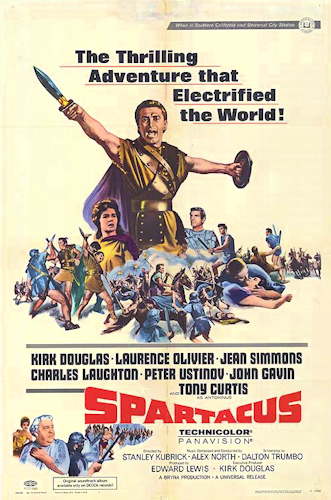
I tend to like more personal and intimate films than big showy spectacles but Stanley Kubrick’s Spartacus proved to be the exception. Maybe it was my love of history or my love of classical actors like Laurence Olivier but this whopping three hour epic didn’t seem nearly that long. There isn’t a dull moment and the big stages, battle scenes, and big names don’t infringe on the story or the characters. Each piece is allowed to flourish and the film doesn’t get its head inflated with its big budget. The reason to see the film isn’t its length or its size but its performance by Oliver as an amazing villain and Kirk Douglas as the titular but human hero. And, no, I’M SPARTACUS!
The Additional Three: Arthur Penn’s Bonnie and Clyde (1967): I just saw it this last semester in my film history class but I’ve never seen a film so beautiful walk the border of being sympathetic with villainous behavior while failing to condone it. Fascinating New Hollywood character study asking us why we do choose to do bad things. Stanley Kubrick's Dr. Strangelove: Or How I Learned to Stop Worrying and Love the Bomb (1964): I don’t like films that shove political messages down your throat but this one does so with such finesse and humor that it is awesome. Terrence Young's Wait Until Dark (1967): A smart thriller that doesn’t rely on jump scares to get you sucked in and your adrenaline pumping.
 |
1980’s: Ferris Bueller's Day Off (1986)
From this point on I’m just going to revert to listing the decade instead of numbers because I feel like I’m betraying every film listed above if I continue to count down numbers to an arbitrary number one. This movie does have possibly one of the best villains in cinematic history in Ed Rooney, the school dean, but that is just another personal opinion. Despite the fact that this film doesn’t depict in any way, shape, or form how my high school experience was, somehow this captures my transition from high school to college. I remember watching Ferris Bueller's Day Off with some friends the day before I drove up to Provo to move into my freshman apartment. As funny as a movie it is, it somehow captured everything I was feeling at that transition stage.
It made me think, what am I leaving behind in Vegas and what am I taking with me? I was anxious to move from my home of 18 years away from my parents while excited at the same time to start my life as an independent human. Ferris Bueller somehow eased my fear just a little bit. My life was mine for the taking. Maybe I was like Cameron for most of high school but now was the time to be a little more free spirited like Ferris. I didn’t start skipping school because of the film but I became more conscious of my imprint I left around others and the weight of my actions. I wasn’t going to be the popular emignic Ferris but I strove to be the braver Cameron we see at the end.
The Additional Three: Robert Zemeckis' Back to the Future (1985): Time travel is perhaps the thing that makes science fiction the best- and Christopher Lloyd. Steven Spielberg’s Raiders of the Lost Ark (1981): Punching Nazi’s that try to mess with archaeological artifacts is just beautiful. Made me love Harrison Ford. Milos Forman’s Amadeus (1984): I never thought I could care as much about Mozart dueling with another villainous musician. Crazy good sets and acting to boot.
 |
Whenever I tell people I am studying to be an archaeologist, they usually either think I study dinosaurs (WRONG!!!) or ask if I want to be an Indiana Jones. Funny enough, I had already fallen in love with history long before seeing the Indiana Jones series as a teenager. It really had little to no influence on me choosing to study archaeology in college. Funny enough, I think 20th Century Fox’s Anastasia is the movie that influenced me the most in my career aspirations.
I know it might not be the most historical accurate but it brought history to life for me. I first was exposed to Communists, Russia, and the Cold War as I watched this film as a toddler. It was, to steal a lyric from the movie, my own journey to the past, discovering a world outside of my own, geographically, culturally, and chronologically. It taught me about love too when Dimitri didn’t take his reward money as his desires and wants changed the person he was. Now the film itself is a journey back into my own past as I’ve come to love studying history and film thanks partly to this one film.
The Additional Three: Disney's Lion King (1993) & Pixar's Toy Story (1995): Ask my mom, I watched these two movies back-to-back to back-to-back as a kid. Some of my first favorite movies that still capture my imagination to this day which grows with each subsequent viewing. Robin Williams in Mrs. Doubtfire (1993): My sister and I told our babysitter our parents let us watch PG-13 movies and I’ve been a huge Robin Williams fan ever since. James Cameron’s Titanic (1997): The first critically acclaimed Oscar bait movie I ever remember seeing. Still haven’t gotten over historical dramas brought to life or the fact that there totally was room for two!
 |
Sundays in the Hall home growing up were pretty orthodox even for most Latter-day Saints. Our family strove to keep the Lord’s Sabbath Day holy so for us that meant no television or video games. Movies were fine as long as they helped us come to closer to God. Us as kids erroneously assumed that that meant they had to be strictly Mormon in content. I remember our cousin came to visit and suggested we watched The Sound of Music one Sunday and I kind of felt like I was breaking a rule watching it. My dad came in and said, “I love this movie! What a great choice for Sunday watching!” and I was kind of confused. So for a long time we only watched the Animated Book of Mormon Stories (still love those) and Mormon comedies.
My favorite of these was The Best Two Years, a film following four LDS missionaries in Holland. One missionary has given up and is counting down the days until he is released and goes back to America when he gets a brand new missionary as his companion who is ready to work and excited to spread the gospel of Christ. I remember watching it for the first time as a family and thought, “That’s not how missionaries are. But it’s still pretty funny”. Fast-forward a few years and I learned from my own LDS mission that indeed, that is how missionaries were, real humans with real problems. It is how I came to grips with my new life as a missionary and upon coming home from Japan, it stopped being a comedy and turned into a spiritual film for me. I felt the doubts and lack of motivation Elder Rogers struggles with in the film but I also knew the fervent energy Elder Calhoun brought to the field. The spiritual journey of these missionaries coming to grips with their own weaknesses and challenges to grow closer to God still inspires me as a disciple of Christ long after my own two years in the service of God.
The Additional Three: Shia LaBeouf in Holes (2003): One of my family’s favorite movies. It taught me how to dream and impressed upon me how film can stretch the imagination. Clint Eastwood’s Million Dollar Baby (2004): I don’t think I’ve been surprised by a movie like this before. I thought I was gonna be watching intense boxing matches, not crying throughout the third act non-stop. Nic Cage in National Treasure (2005): At this point I don’t even care what everyone thinks, one of my favorite adventure movies ever, hands down.
 |
2010’s: Tangled (2010)
It is rare for me to go to a theatre and watch a film that changes my life forever. Tangled happens to be the exception to that rule. We begged late one afternoon during Thanksgiving weekend for my family to take my sister, my cousin, and I to see Disney’s newest movie. Luckily they caved and we kept our tradition of seeing a Thanksgiving movie ongoing. Alan Menken’s songs were beautiful as always and the animation was top-notch too but the story is what really captivated me.
I remember leaving that theatre and piling into my dad’s blue F-150, half-listening to my family rave about the movie while I stared out the window deep in thought. It probably would have eventually happened with all of my hormones raging in my 15 year old teenage body but it was that moment I realized I was missing something. I felt as if I had a hole in my heart, I was Flynn Rider and I needed my Rapunzel. It is cheesy and cliche and I know but that is really what was pulsating through my mind then. The world had somehow shifted and suddenly I saw my dream, my future. Even eight years later, this movie shapes what I look for and desire in relationships. This film was the impetus for years of searching myself to find who I was and who I wanted to spend my life with. My understanding of relationships and love stemmed from this desire to find someone who I can share my dreams with and who I can rely on and support amidst hard times.
I think that is the essence of great cinema, it makes us ask questions. Very rarely have I seen a movie that gives me a clear cut answer. It isn’t the end of my search but often the beginning. Movies aren’t something we should go and watch to get away from the world. They shouldn’t distant and distract us from our lives but connect and draw us to them. That is what movies have done for me. They’ve not only let me see places and time periods I’ve never been able to experience but they let me ask questions I’ve never thought of before, let me experience stories I’ve never come in contact to, and allow me to experience a myriad of emotions while sitting on the living room couch, a dim-light movie theater reclinable chair, or my own bed. That is what Tangled and so many other films on this list have done for me. I can honestly say that besides my family, close friends, and my belief in Christ and His church on the Earth today in the Church of Jesus Christ of Latter-day Saints, film has been the most important factor in helping me become a better person. Film as a medium has helped me better understand my purpose in life, how I should shape my life to reach joy, and how to help others experience the same.
The Additional Three: Christopher Nolan’s Inception (2010): I saw this on my 15th birthday with my dad in theatres and fell in love with the intricate story, jaw dropping special effects, ambivalent ending, and Christopher Nolan. Martin Scorsese's Silence (2016): A religious journey that connects well with my two year LDS mission in Japan. Pixar's Coco (2017): I could only pick one Pixar movie but this one blends a heartfelt story with stunning visuals to make you appreciate your family, warts and all. Overwhelmingly heartwarming and what cinema should always be.
Well, I hope you enjoyed and got to know me better and hopefully yourself too. Now, forget about leaving argumentative comments like on other top tens and share with others some of your favorite films or go discover your new favorite film!
Recap:
1920's (Comedy): The Kid
1920's (Drama): Sunrise: A Song of Two Humans
1930's: All Quiet on the Western Front
1940's: The Best Years of Our Lives
1950's: Sunset Boulevard
1960's: Spartacus
1980's: Ferris Bueller's Day Off
1990's: Anastasia
2000's: The Best Two Years
2010's: Tangled
WOW. Well done. I love how are follows, cradles, and shapes us. I totally agree with you! This is why you tens are lame, artb can't REALLY be a competition, because the consumption is so dependent on the experiences of the consumer.
ReplyDelete