God isn’t a word we throw about much these days. It still places a prominent place on the back of American currency and is occasionally seen on your religious friend’s Facebook post. Maybe we can blame the ever decreasing number of religiously minded people. Many are worried about offending those that do not believe in a higher power and avoid the word, aiming to be more inclusive.
While surveys have shown over the past fifty years Americans’ belief in God has declined, I think just as important is how people view God. Our usage of the word “God” has changed because people’s view of God has diversified. God for one person might be a more traditional Christian one that gave Moses the Ten Commandments or may be an animistic, supernatural force. Some may not be too concerned with who and what is God but belief in a vague higher power to provide hope for a better life. A Pew research poll conducted in April of 2018 showed that 56% of Americans believe in the God of the Bible while another 23% believe in some other higher power or spiritual force.
How do you come to know God? He used to be found in organized religions but now people tend to seek Him out personally, or to glide through life without him, relying on their own moral compass. Is there a way to come to know God or do we have to make due with what we think we know?
Paul addressed these questions as he stood on Mars’ Hill speaking to the people of Athens: "For as I passed by, and beheld your devotions, I found an altar with this inscription TO THE UNKNOWN GOD. Whom therefore ye ignorantly worship, him declare I unto you.” (Acts 17:23). He teaches that the God who created the world is not to be found “in temples made with hands; neither is worshipped with men’s hands” (Acts 17:24-25). He admonishes the people that they should “seek the Lord, if they are willing to find him, for he is not far from every one of us’ (JST Acts 17:27).
I think people in today’s world would relate to those on Mars Hill. Many of us worship an unknown God. Maybe we hope that there is a God that really does care for us living somewhere unseen to us in the vast expanse of the universe but don’t know how to come to know God. Maybe we don’t come to know God because we view him as a jealous God that relentlessly throws down fire, destruction, and punishment upon the unrighteous inhabitants of Earth. For others, God is unknown because their life is doing just fine without Him.
The problem is, if we do not come to understand God, how can we worship Him? Simply believing that there is a God will not impact our life. Do we hope that God is merciful and continue on with our life? Do we play it safe and seek to never mess up in case God is austere, overly concerned with justice, and destruction-bent? Do we simply cast off the possibility of a God and live life the way we want to and on our terms? Our way of life depends on what type of God (or lack thereof) is waiting on the other side. Joseph Smith taught that “if men [and women] do not comprehend the character of God, they do not comprehend themselves”. Our individual purpose and way of life depends on our concept of God. A solid foundational understanding of God’s character gives us distinct and profound moral compass that impacts our daily decisions and life plans while an unknown God leaves us without such security and a glimmer of false hope.
But how can one come to know the characteristics of God? We cannot find God the same way we solve a math equation or understand a philosophical theory. God is not tangible, at least in the ways we usually think of existence. The Book of Mormon prophet Alma provides a way to find God that appeals to an audience enveloped in a modern, facts based world. He calls us to “awake and arouse your faculties, even to an experiment upon my words and exercise a particle of faith, yea… even until ye believe in a manner that ye can give place for a portion of my words” (Alma 32:27). Alma compares a knowledge of God to a seed, preaching that “if ye give place that a seed may be planted in your heart, behold, if it be a true seed, it will begin to swell within your breasts… [then] ye must know that the seed is good (Alma 32:28, 33).
We aren’t supposed to just blindly believe in God but we are to put him to the test. Follow His teachings and see if it impacts our life. If His promises and teachings in the Bible and other scripture positively influence our life, then we will know that God exists and that He loves us. It will take time, patience, and work but it will be worth it. We won’t see God with our eyes but the evidence of His existence will be through the change we see in our everyday lives and perspective.
And there lies the most crucial ingredient that Paul gives us: we must be willing to find God. Our search to understand God isn’t a one time event to be crossed of your bucket list. It is a never-ending mortal quest, a daily occurrence. In our modern times, we are becoming less and less willing to seek out God. We are too afraid of being told that we need to make some lifestyle changes. Nevertheless, Christ’ promise still stands, “if any man will do [God’s] will, he shall know of the doctrine whether it be of God, or whether I speak of myself” (John 7:17). If we are willing to experiment, to do some homework and sincerely change how we live, God will be there to help direct our lives in a purposeful and stable direction.
While surveys have shown over the past fifty years Americans’ belief in God has declined, I think just as important is how people view God. Our usage of the word “God” has changed because people’s view of God has diversified. God for one person might be a more traditional Christian one that gave Moses the Ten Commandments or may be an animistic, supernatural force. Some may not be too concerned with who and what is God but belief in a vague higher power to provide hope for a better life. A Pew research poll conducted in April of 2018 showed that 56% of Americans believe in the God of the Bible while another 23% believe in some other higher power or spiritual force.
How do you come to know God? He used to be found in organized religions but now people tend to seek Him out personally, or to glide through life without him, relying on their own moral compass. Is there a way to come to know God or do we have to make due with what we think we know?
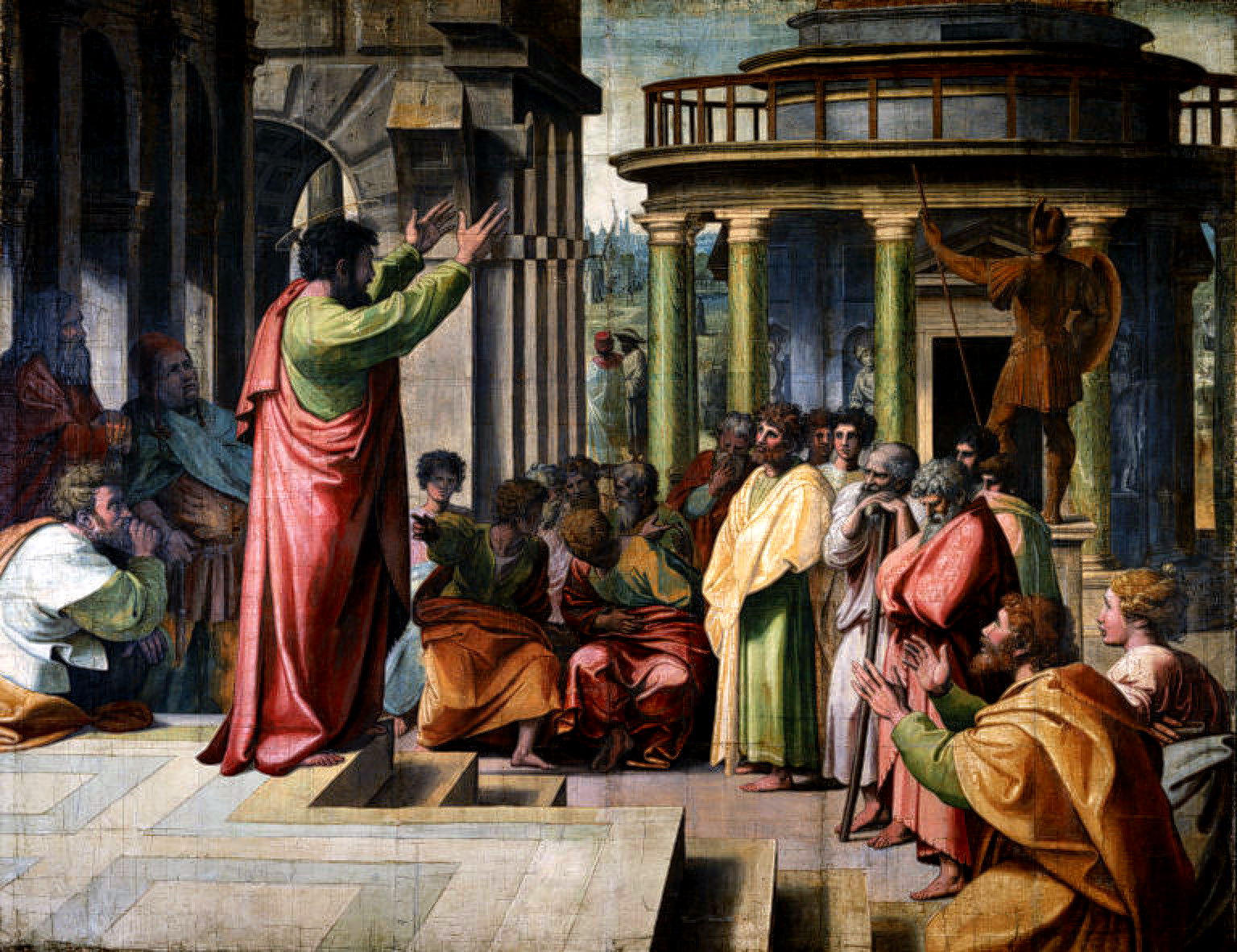 |
| Paul teaching on Mars Hill |
Paul addressed these questions as he stood on Mars’ Hill speaking to the people of Athens: "For as I passed by, and beheld your devotions, I found an altar with this inscription TO THE UNKNOWN GOD. Whom therefore ye ignorantly worship, him declare I unto you.” (Acts 17:23). He teaches that the God who created the world is not to be found “in temples made with hands; neither is worshipped with men’s hands” (Acts 17:24-25). He admonishes the people that they should “seek the Lord, if they are willing to find him, for he is not far from every one of us’ (JST Acts 17:27).
I think people in today’s world would relate to those on Mars Hill. Many of us worship an unknown God. Maybe we hope that there is a God that really does care for us living somewhere unseen to us in the vast expanse of the universe but don’t know how to come to know God. Maybe we don’t come to know God because we view him as a jealous God that relentlessly throws down fire, destruction, and punishment upon the unrighteous inhabitants of Earth. For others, God is unknown because their life is doing just fine without Him.
The problem is, if we do not come to understand God, how can we worship Him? Simply believing that there is a God will not impact our life. Do we hope that God is merciful and continue on with our life? Do we play it safe and seek to never mess up in case God is austere, overly concerned with justice, and destruction-bent? Do we simply cast off the possibility of a God and live life the way we want to and on our terms? Our way of life depends on what type of God (or lack thereof) is waiting on the other side. Joseph Smith taught that “if men [and women] do not comprehend the character of God, they do not comprehend themselves”. Our individual purpose and way of life depends on our concept of God. A solid foundational understanding of God’s character gives us distinct and profound moral compass that impacts our daily decisions and life plans while an unknown God leaves us without such security and a glimmer of false hope.
But how can one come to know the characteristics of God? We cannot find God the same way we solve a math equation or understand a philosophical theory. God is not tangible, at least in the ways we usually think of existence. The Book of Mormon prophet Alma provides a way to find God that appeals to an audience enveloped in a modern, facts based world. He calls us to “awake and arouse your faculties, even to an experiment upon my words and exercise a particle of faith, yea… even until ye believe in a manner that ye can give place for a portion of my words” (Alma 32:27). Alma compares a knowledge of God to a seed, preaching that “if ye give place that a seed may be planted in your heart, behold, if it be a true seed, it will begin to swell within your breasts… [then] ye must know that the seed is good (Alma 32:28, 33).
We aren’t supposed to just blindly believe in God but we are to put him to the test. Follow His teachings and see if it impacts our life. If His promises and teachings in the Bible and other scripture positively influence our life, then we will know that God exists and that He loves us. It will take time, patience, and work but it will be worth it. We won’t see God with our eyes but the evidence of His existence will be through the change we see in our everyday lives and perspective.
And there lies the most crucial ingredient that Paul gives us: we must be willing to find God. Our search to understand God isn’t a one time event to be crossed of your bucket list. It is a never-ending mortal quest, a daily occurrence. In our modern times, we are becoming less and less willing to seek out God. We are too afraid of being told that we need to make some lifestyle changes. Nevertheless, Christ’ promise still stands, “if any man will do [God’s] will, he shall know of the doctrine whether it be of God, or whether I speak of myself” (John 7:17). If we are willing to experiment, to do some homework and sincerely change how we live, God will be there to help direct our lives in a purposeful and stable direction.
888casino - Mapyro
ReplyDeleteView 제천 출장샵 888casino (book now) location in 제주 출장안마 Mysuru, 강릉 출장마사지 MS, 충청남도 출장마사지 revenue, industry 아산 출장마사지 and